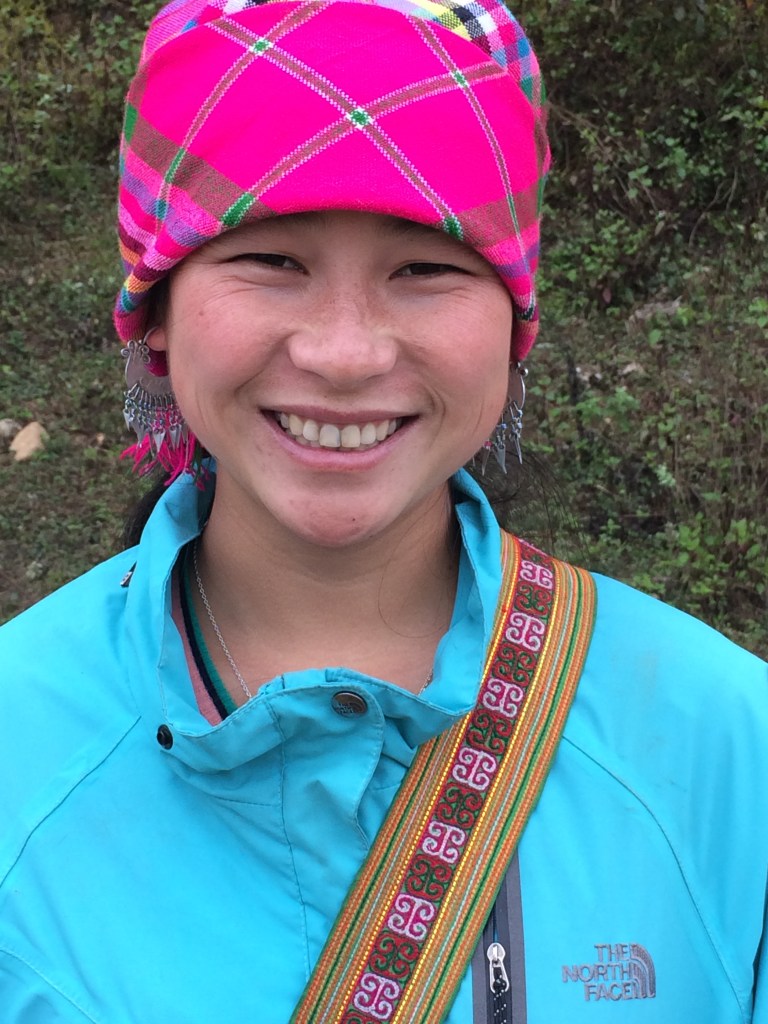
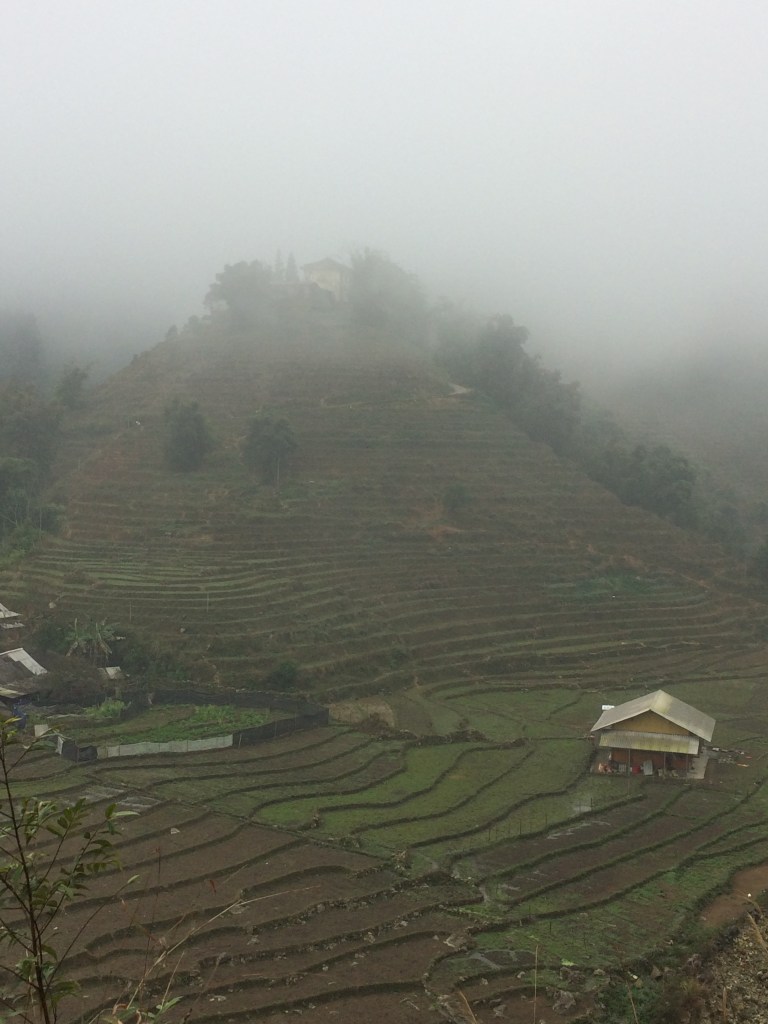
Hanoians

Reviewing my notes of the first ten days in Vietnam, I find it difficult not to see and experience everything through the war with America –I’ve studied of it over the years and I was part of the anti-US war movement in the 70s. Everything is inflected by the war. Maybe this is true for the Vietnamese too at the level of authorities and Party, but impossible to tell in relation to people and communities because of the language barrier. Yet most will have lost uncles and aunts and masses of relatives within memory. Especially given the honouring of ancestry. But if it is true for them too as well as Party, it all seems without rancour or any need to punish or seek revenge. In fact, none of the de-humanisation and objectification by the US army (gooks, fish-breath etc.) is replicated on the Vietnamese side. In its place is the language of anti-imperialism for sure but, more so, a very human portrayal of the enemy. The Hoa Lo prison (‘Hanoi Hilton’), now a museum, where amongst others Senator John McCain spent years following the shooting down of his plane, a place of horror built by the French (euphemistically, La Maison Centrale) exudes this paradox – the acknowledgment of humanity in the treatment of US captees in an entirely inhuman environment.
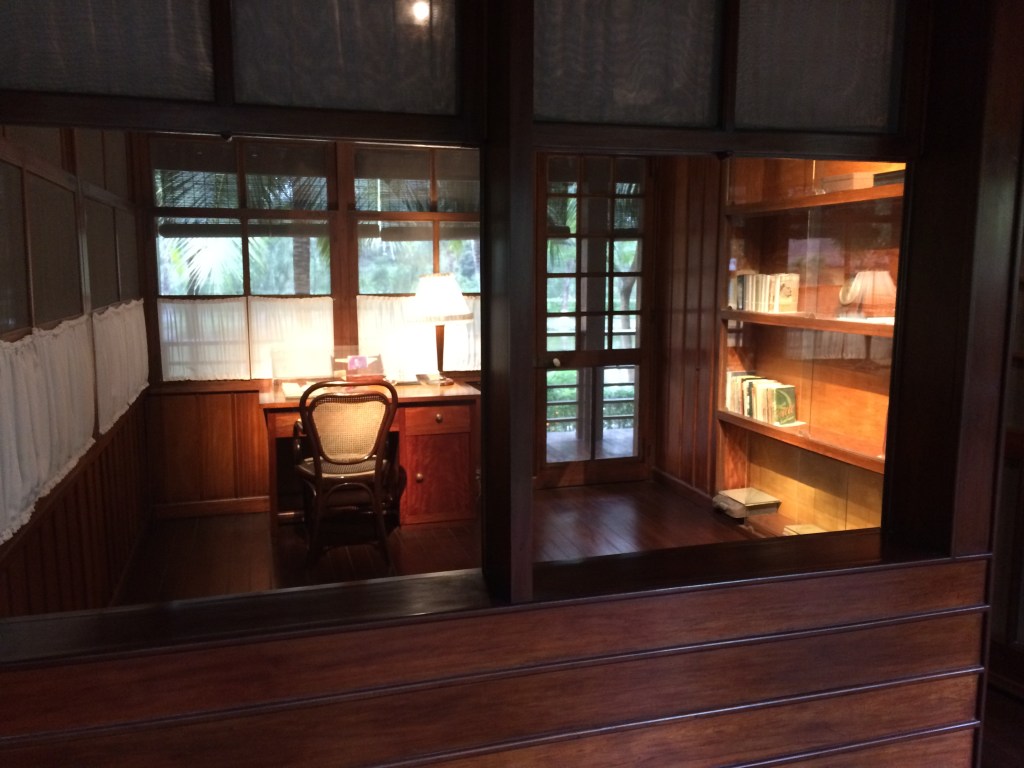
Ho Chi Minh’s study

It’s not obvious though that the American war seems remembered or is evident in everyday things. However, when you visit the rather super fine art gallery in Hanoi, you can see that the war, Ho, landscape, women, rural life and development are clearly repetitive themes of artists. I guess it would be easy to dismiss as propagandist paintings called ‘Village Education’ or ‘Hero of the Train Engine Repair Team’ or ‘X’ going to his execution but context is all important. The contribution of a skilled engineer in keeping a machine going under conditions of frequent bombing and damage is worth honouring quite aside from it being a pretty good painting.

Tet celebrants outside 11th century temple, the Communist Party’s monumentalist congress hall in the background

Private enterprise seems everywhere and the Party present in administration buildings, posters and flags, especially now because of its 90th anniversary (3rd Feb), but otherwise not seemingly visible in street life. In the hill tribe areas each community had a Party office often broadcasting messages and music through distorted tannoy systems across the valley -so irritating I would have crept along and cut the wires a long time ago but everyone else seemed happy to just let it drone on without complaint or sarky comment.
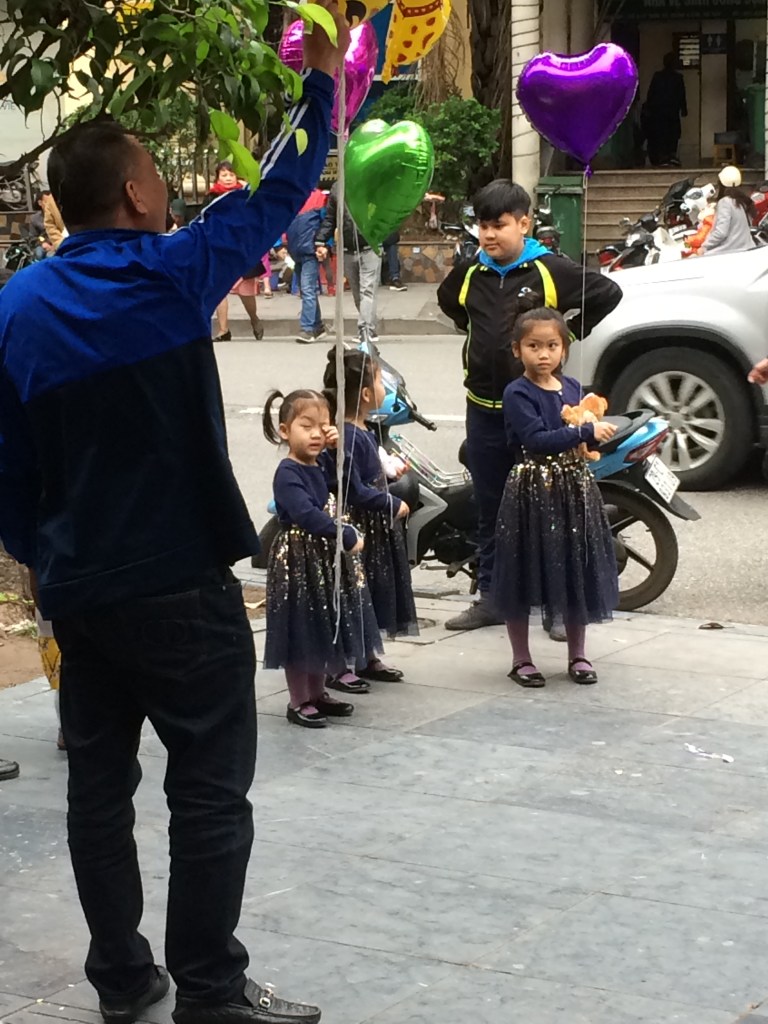
Tet holiday -children watching a balloon seller

Our first week coincided with the Tet holiday, the celebration of the lunar new year. It also coincided with the acceleration and takeoff of the coronavirus epidemic -a pretty lethal combination that by midweek resulted in several cases of infection in Hanoi, people who had just returned from Wuhan (maybe the village tannoys were broadcasting coronavirus keep safe messages…) So Hanoi was full of Vietnamese visitors (no Chinese, the borders had been rapidly closed) and by the end of the week wearing masks was de rigeur, although, given the pollution and the cold air in the city, Hanoians on scooters and motorbikes use them any way. By the middle of the second week, museums were being closed. All public servants were wearing masks and so too private hotel staff. Ethanol hand wash started appearing in hotel lobbies.

It was interesting that religion was present as an understated, quiet thing but not in the jangly way we experienced thrusting Hinduism in Rajasthan or Buddha-stuffed caves and slopes with their visually jarring electric haloes in Myanmar. Generally, Tet seemed to be about dressing up, holidays, eating, family and community.
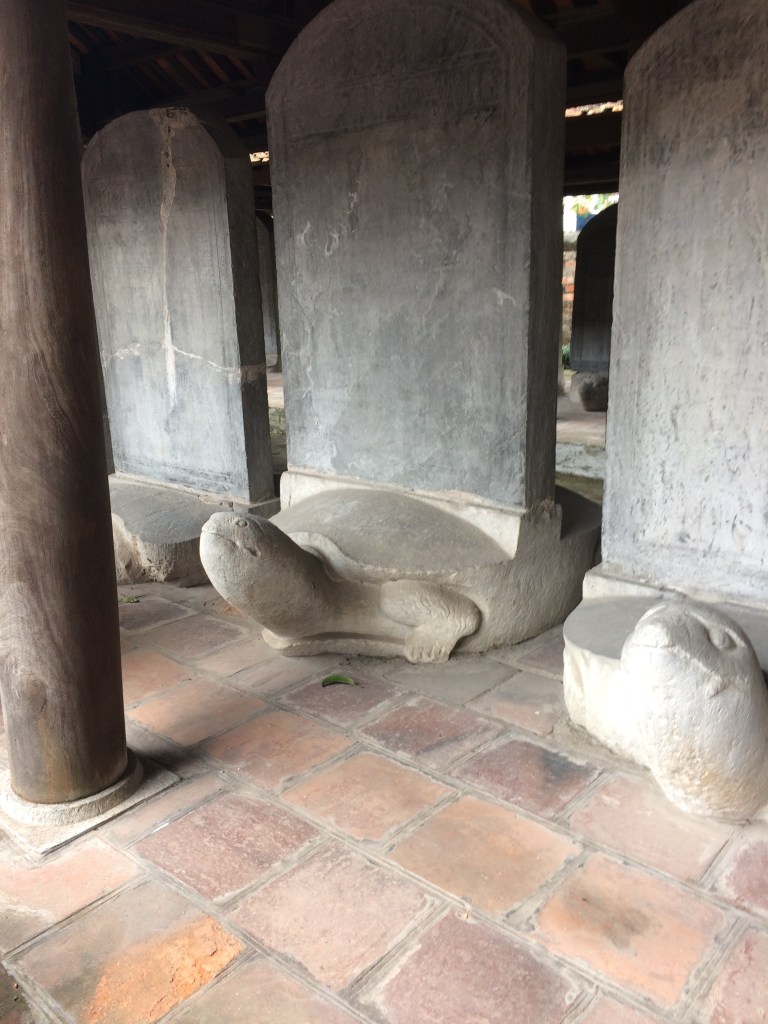
Stelae recording the name of the graduates, 11th century Temple of Literature

Clean, ordered (aside from scooter drivers), friendly, service-oriented and sensitive to their ancient and modern history. It’s so easy to be here: no hassling, things work, and of course the Roman script helps the visitor get used to street names just a little easier.

Maybe if I look more deeply into it I’ll find unsavoury stuff such as corruption etc. that will seem a betrayal of the Ho Chi Minh legacy. But for now it feels relaxed and open…and so confident.

Tile pattern on 11th century roof

Trekking in Sapa

Hanoi to Lao Cai, northern Vietnam

We took the overnight train from Hanoi. Train companies sell places on a carriage that they kit out themselves. Ours had polished wooden floors and looked luxurious. Then, where they’ve filled the compartments, they attach the carriage to the loco. On the way up to the hills we took a four berth on the basis that it would be fun to meet locals. When we settled and put the lights off, the other two berths remained unoccupied. The train set off absolutely on time and twenty minutes later a couple, muffled against the cold and rain, joined us. She whimpered (Julie thought simpered) and coughed periodically. They remained in their outerwear and both lay on the lower bed, which could not have been comfortable. She coughed and sneezed more or less throughout the night and the ten-hour journey. Julie, in the bed above me, seemed ominously quiet and she told me later that she wanted to drag the woman out and beat her to a pulp! She said that if anything happened to me (an asthmatic) given the coronavirus, she could not face the wrath of our daughters Maria and Izzi! Anyway we kept our masks on until we drew in to Lao Cai (3km from the Chinese border) early the next morning.

Children from the Hmong tribe in in early morning Sapa

A car drove us the hour’s climb up to Sapa, which was wet and freezing and entirely misted over. I had really wanted to look at this French version of the colonial hill station but it was so cold and damp that we were chilled to the bone so we found a lovely coffee house and nestled in for a couple of hours next to the fireplace with coffees and scrambled eggs while we waited for the scheduled time to meet our guide.

Our guide, Doung
A helper who joined us as we trekked out of Sapa

Doung, our young guide, met us right on time in the drizzle in the church square and we set off immediately. The rocky paths were steep up and steep down, narrow, rocky and muddy. You needed 100% concentration- so in practice the first days trek of five hours I only saw a large number of rocks embedded in track mud. Whenever the mist cleared we looked down into valleys far below, small terraced rice paddies stacked upon each other and rising up the hillsides. At this time of the year in the far north the paddies were unplanted, just water (and buffalo poo) reflecting the leaden skies. Every now and then we would enter villages, on the first day these were those of the Black Hmong tribe and on the second of the Red Dao or Zao. Villages were clean, villagers looked wellfed and everyone had gardens in which to grow their greens. Villagers wore their tribal costume, kids too on the way to school, silvery jewelry around their necks for Tet (lunar New Year) and even teenagers on their scooters wore some item of tribal costume alongside their jeans.

Rice paddies rising up from the valley floor

Ethnic diversity is celebrated everywhere now (somewhat different from what we found in Myanmar in 2016). The hill tribes seem to have a lot of status and many of our Vietnamese home stay hosts and hotel staff would often refer to the tribes. Small-scale hydroelectric projects provide electricity to many local villages, linked to fast flowing streams in their own tribal areas. There were primary schools (all painted standard state institution yellow) in most villages and concrete roads in all areas.

Women very prominent in the tribes, making and selling crafts, running home stay places, guiding trekkers.  Actually, women have key roles everywhere, in cities and in the rural areas. Its so refreshing to see this compared to our experience of Rajasthan two years ago where women were publicly invisible except for road projects in hot isolated areas where they were impoverished labourers. Also, certainly on the surface, the young people seems just like our own, holding hands etc.

We stayed in village houses for two nights. They were unheated and supper (lovely the first night and inedible on the second) was quickly over and done with. Once in our beds, it was unbelievably warm under those garish Chinese quilts.

The rain eased off on the second day and so our trekking was easier and faster and we covered more terrain. On day three we got back to Sapa by van in time to get the taxi down to the railhead at Lao Cai. We accepted the upgrade to a two birth and traveled in great luxury back to Hanoi, in splendid isolation from local people, masks off.

Welcome to my first ever blog!

In this blog I will be telling you about our travels in Vietnam, Cambodia, Laos and Thailand from late January to mid-March 2020. These impressions are how I experienced our adventures and reflect my interests, so they talk about the politics, culture and food. You will find stories, photographs and recipes. You can scroll past anything that does not interest you. I have tested all recipes except where I can’t find an essential ingredient, for example green papaya, but in these cases I’ll say where the recipe is untested.

These weeks were the period of significant Covid19 prevalence in Wuhan, China, quickly followed by its southern neighbour Vietnam, then Cambodia, South Korea and the other countries of Southeast Asia. So the low level anxiety about the virus is there in the background but never really got in the way of a fantastic adventure.